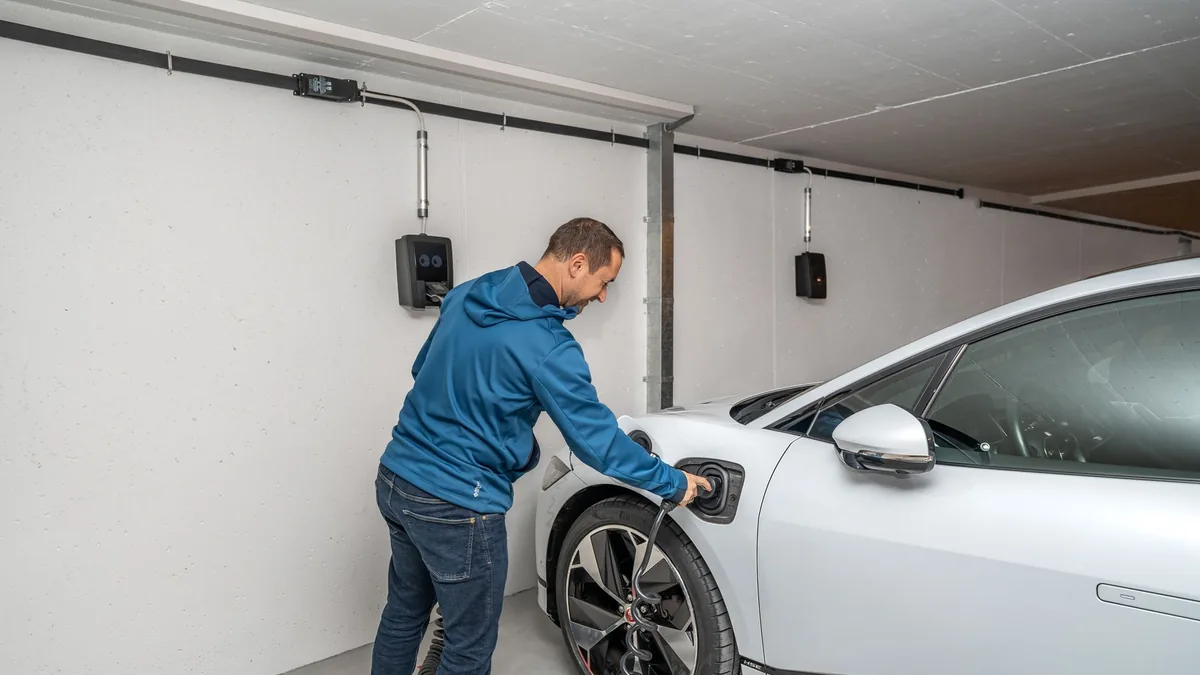
EV Charger Installation in Winston-Salem, NC
Home EV charger installation from Winston-Salem Solar gives your electric car a full battery every morning without a trip to a public station. We install Level 2 chargers in garages and driveways across Winston-Salem, Clemmons, Lewisville, and Bermuda Run, with the wiring, breaker, and permit handled properly.
- Level 2 home chargers, wired and permitted
- Electrical permits filed with the City of Winston-Salem Inspections Division
- Works with or without solar on the roof
Get a Free Solar Quote
Tell us what you need — we’ll get back to you fast.
We'll be in touch shortly.
Please call us at (336) 360-3767.
Why a Level 2 Charger
Most electric cars come with a cord that plugs into a regular household outlet. It works, but slowly: many drivers find it barely keeps up with a normal commute, and a long weekend drive can leave the car short on Monday. A Level 2 charger runs on a 240-volt circuit, the same kind of circuit a dryer or range uses, and refills most cars overnight.
A Level 2 charger is a dedicated appliance. It needs its own breaker, wire sized to the load, and a mounting spot within reach of where you park. Some homeowners choose a hardwired wall unit; others prefer a plug-in unit on a properly installed 240-volt outlet. We help you choose based on your car, your garage, and how you plan to charge.
If you drive more than one electric vehicle, or plan to, we can set up two chargers to share one circuit so they do not overload your service.
What the Install Covers
Panel check
Your main panel's capacity reviewed before anything is ordered.
Dedicated circuit
New breaker and wire sized to the charger's load.
Mounting
Charger mounted where the cable reaches your car without a trip hazard.
Permit and inspection
Electrical permit filed and inspected by the city.
The Process
From Quote to First Charge
Site Check
Panel capacity, distance to parking, and charger choice.
Quote
A written price with the circuit, mounting, and permit spelled out.
Permit
Electrical permit filed with the City of Winston-Salem Inspections Division.
Install and Test
Circuit run, charger mounted, inspected, and tested with your car.
Permits, Panels, and Licensed Work
A home charger is a new 240-volt circuit, and that is regulated work. Under North Carolina's rules an electrical permit is required whenever wiring or equipment changes, so every charger we install is permitted through the City of Winston-Salem Inspections Division at the Bryce A. Stuart Municipal Building, 100 E First Street and inspected before you plug in. It is the same standard we follow on solar, where solar PV installations of any value require a North Carolina electrical contractor licence.
The biggest variable in cost is your electrical panel. Many newer homes out toward Bermuda Run and Clemmons have room for a new 240-volt breaker. Older houses in the West End, a historic district built mainly between 1887 and 1930, and parts of Ardmore, the city's largest neighborhood, may have smaller services that are already close to full, and some need a panel upgrade or a load-management device before a charger can go in. We check that first, so the quote you get is the price you pay.
Distance matters too. A charger mounted on the garage wall right beside the panel is a short, simple run. A charger at the far end of a driveway needs a longer, larger wire and sometimes a trench.
Charging With Solar
An electric car is one of the largest loads in most homes, which makes it a good fit with solar. Under current rules, net exports are credited at the utility's avoided-cost rate, so power your panels make and your car uses directly is worth more to you than power sent back to the grid. Charging during the day, or storing solar power in a battery for overnight charging, uses more of your own production.
If you are thinking about panels, solar panel installation and a charger can be designed together so the wiring and panel capacity are planned once. If you want to charge overnight on stored solar power, see our solar battery storage page.
The Piedmont's hot, humid summers and cool winters are easy on batteries and chargers alike, but a garage-mounted unit still lasts longer than one exposed to summer sun and storms. We will recommend the best mounting spot for your home.
Picking the Right Charger
Charger brands differ in cable length, connectivity, and whether they support scheduling. If your utility offers time-of-use pricing, a charger that can schedule sessions for low-price hours is worth having. We will go over the options that fit your car and your panel, and install the model you choose.
What It Costs and How Long It Takes
Most charger installs are finished in a day once the permit is issued. The price depends mostly on three things: the charger you pick, the distance from your panel to where you park, and whether the panel has room for a new 240-volt breaker. A short run on a panel with spare capacity is the simplest job; a long run, a detached garage, or a panel upgrade adds time and cost.
We put all of that in a written quote before you commit, including the permit and inspection. If you rent, live in a townhome with an association, or park in a shared lot, check the rules for mounting and wiring before you buy a charger. We are glad to help you sort out what the install would involve so you can bring a clear plan to your landlord or association.
Get a Charger Quote
Ready to charge at home? Get a free quote or go back to the home page.